



Internal communication rarely fails because organisations lack channels. In most cases, the tools are already in place: email, intranet, chat, meetings. The challenge is that communication becomes harder to manage as organisations grow, teams become more distributed, and information needs to be shared more frequently and more consistently.
In many organisations we work with, the same patterns tend to emerge over time. Important updates get lost in inboxes, onboarding depends on who happens to be available, and the same topics are explained repeatedly in slightly different ways. None of this is dramatic on its own, but together it creates inefficiencies that slow things down and make alignment harder than it needs to be.
Video helps address these challenges, not simply by making communication more engaging, but by making it more consistent, repeatable, and accessible when needed.
From one-time communication to reusable content
A key difference between video and many traditional internal communication formats is that video can be reused without losing context. A written message often requires interpretation, and a live session is tied to a specific moment, but a recorded video can be revisited, shared, and used across teams without additional effort.
This changes the role of communication. Instead of being a one-time activity, it becomes something that can be built on over time. Rather than repeating the same information in different formats, organisations can create a structured library of content that supports onboarding, training, and internal updates.
In practice, this often means moving toward centrally managed video environments, where content is searchable, versioned, and accessible across teams without relying on manual distribution.
Onboarding with consistent quality
Onboarding is often where inconsistencies in communication become most visible. Different teams follow different approaches, and the quality of onboarding can vary depending on time, location, or individual managers.
With video, onboarding content can be standardised so that every new employee receives the same core information, presented in the same way. This reduces the need for repeated sessions and helps ensure that key topics are not overlooked, while also allowing employees to revisit content when needed.
We often see organisations combine this with role-specific onboarding paths, where content is organised by function. This makes it easier for employees to focus on what is relevant to them, while still maintaining a consistent overall structure.
Training that is available when needed
Training is another area where video provides clear operational benefits. Instead of relying on scheduled sessions, organisations can offer on-demand training that employees can access at their own pace and at the point of need.
This is particularly useful for complex processes or systems, where demonstrations and real-life scenarios are easier to follow in video form. Over time, a library of training content reduces dependency on instructors and supports more continuous learning across the organisation.
When this content is integrated into existing internal platforms, rather than stored separately, it becomes part of everyday workflows instead of an isolated training resource.


Clearer updates with more context
Internal updates, such as product changes, strategic initiatives, or policy updates, often require more context than written communication alone can provide. While text remains important, it can be difficult to convey tone, emphasis, and intent clearly, especially when messages are read quickly or out of context.
Video adds this layer of context. Seeing and hearing the message helps reduce misinterpretation and makes it easier for employees to understand what is important, particularly in situations where clarity matters.
Employees are also more likely to watch a short video than read a long text-based update, which supports more effective communication when attention is limited.
Supporting distributed and asynchronous work
As organisations increasingly operate across locations and time zones, communication becomes more asynchronous. This creates a need for communication methods that do not rely on everyone being present at the same time.
Video supports this by allowing teams to share updates, explanations, and progress in a format that can be accessed at any time. Short recordings, screen captures, and video messages can often replace longer message threads or additional meetings, while providing more clarity than text alone.
Making knowledge accessible
A significant amount of organisational knowledge is often tied to individuals or informal communication, which makes it difficult to access when needed. This typically leads to repeated questions, duplicated effort, and unnecessary interruptions in daily work.
Video allows this knowledge to be captured and shared more effectively. When subject-matter experts record explanations, walkthroughs, or best practices, the content becomes available to a wider audience and can be reused across the organisation.
A common challenge here is not content creation, but discoverability. Without proper indexing, tagging, and search, even well-produced video content remains underused. This is why structured video management becomes an important part of the overall solution.
From content to infrastructure
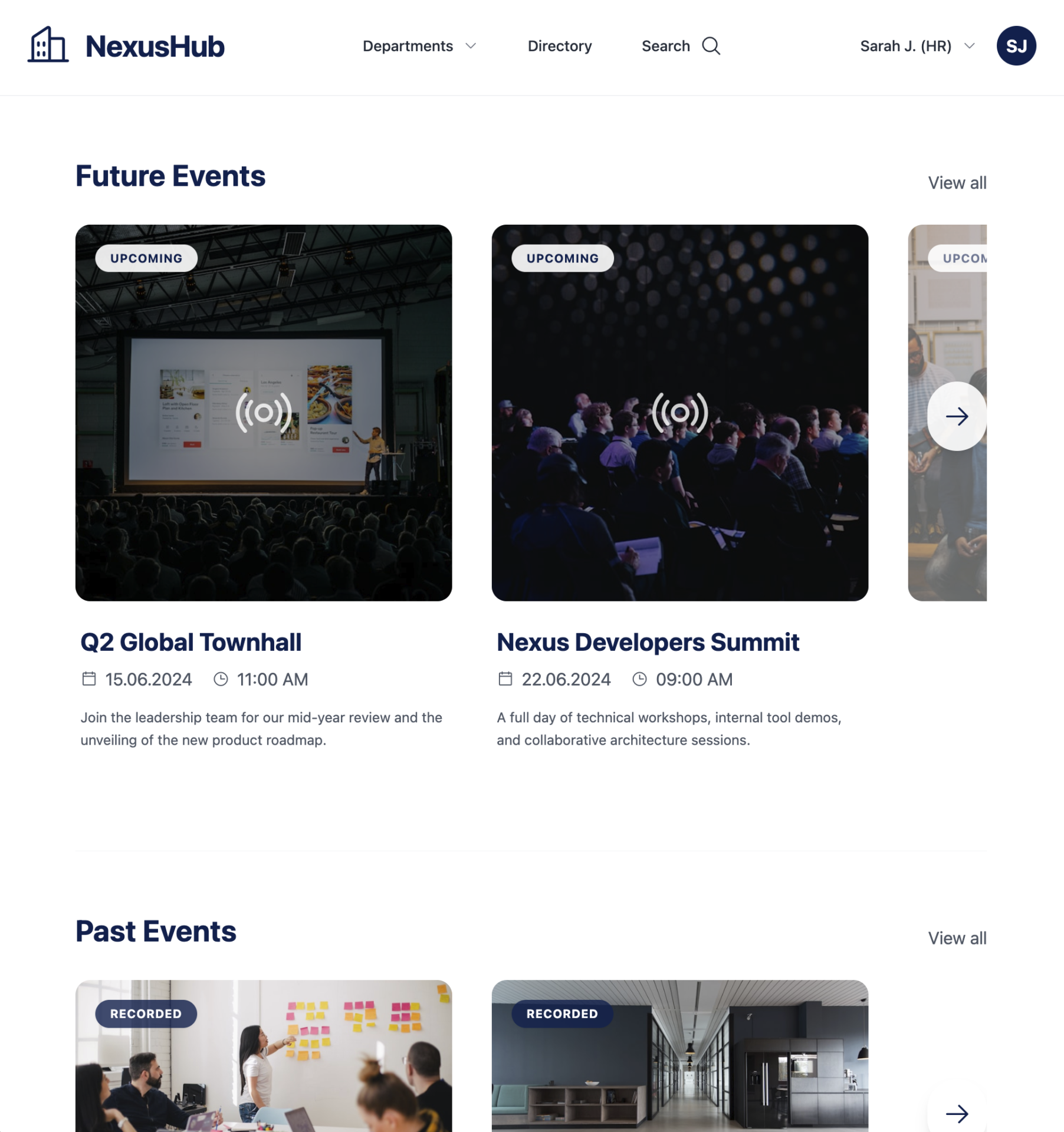
Many organisations already use video in some form, but often as isolated content rather than as part of a broader system. The real value of video emerges when it is integrated into internal platforms, workflows, and communication processes.
From our perspective, the organisations that see the most impact are those that treat video as part of their core communication infrastructure rather than as an additional channel. This typically involves integration with intranets and collaboration tools, centralised management, and the ability to scale usage across different use cases without increasing complexity.
This approach also leads to measurable outcomes. Microsoft, for example, reported a 569% ROI and $13.9 million in annual cost avoidance from its internal video academy, highlighting the impact of reducing repetition and making knowledge more accessible at scale.
Improving communication at scale
As organisations grow, internal communication needs to move beyond ad hoc messages and individual efforts. It requires structure, consistency, and the ability to scale without adding unnecessary complexity.
Video supports this by making communication easier to standardise, distribute, and reuse. When used as part of a broader approach, it helps reduce repetition, improve clarity, and ensure that information is accessible across teams and locations.
Rather than adding more communication, the focus shifts to making existing communication more effective and easier to consume. Over time, this is where meaningful improvements in efficiency and alignment begin to appear.